
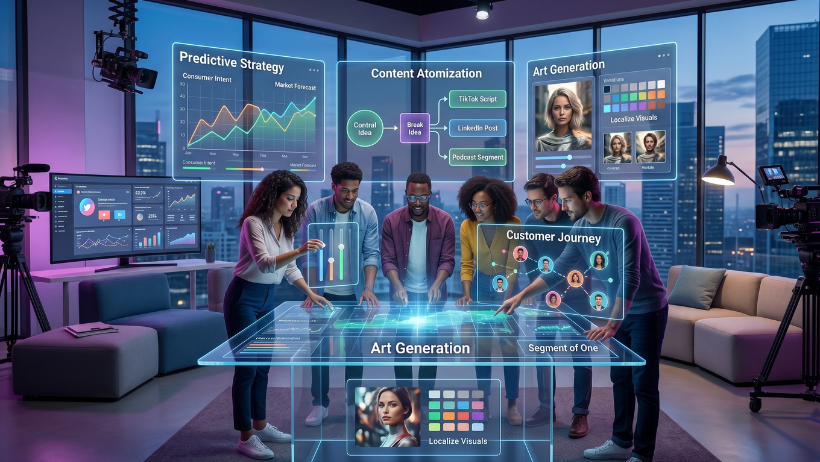
In 2026, artificial intelligence has moved far beyond being a trendy business buzzword. It has become one of the most powerful operating systems behind modern marketing.
AI is no longer limited to writing a quick social media caption or generating a basic blog outline. Today, it is helping businesses plan smarter campaigns, predict customer behavior, personalize content, create high-quality visuals, automate workflows, and scale marketing faster than ever before.
For entrepreneurs, startups, small businesses, and growing companies, the opportunity is clear: businesses that learn how to use AI strategically will be able to compete with larger brands, move faster, reduce wasted effort, and create more meaningful customer experiences.
However, the real advantage does not come from replacing people with machines. The true power of AI marketing strategy in 2026 comes from combining artificial intelligence with human creativity, judgment, ethics, and leadership.
1. AI Is Redefining Strategic Marketing Planning
Before a single advertisement is designed, smart companies are now using AI to evaluate ideas, test market assumptions, and predict campaign performance.
Instead of relying only on instinct, historical reports, or broad demographic data, AI can analyze massive amounts of information, including search behavior, buying intent, customer engagement patterns, social sentiment, website activity, and competitor movement.
This allows businesses to make better decisions before they spend money.
Predictive Campaign Planning
AI-powered tools can now model different campaign scenarios and help identify potential risks before launch. A business can evaluate which message may perform best, which audience segment may respond faster, and where a campaign may experience friction.
This gives leaders a stronger foundation for decision-making.
Instead of asking, “Will this campaign work?” marketers can now ask, “Which version of this campaign has the highest probability of success?”
Smarter Customer Journey Mapping
Traditional marketing often grouped customers into broad categories such as age, income, gender, or location. While those data points still matter, AI allows businesses to go deeper.
AI can identify micro-behavior signals such as browsing patterns, content engagement, purchase hesitation, cart activity, email response behavior, and repeat visits.
This helps companies understand where a customer is in the buying journey and what message may move them closer to action.
Competitor Intelligence in Real Time
Another major shift is the rise of AI-powered competitor monitoring.
Businesses can now use automated systems to track changes in competitor pricing, product positioning, website messaging, customer reviews, social media activity, and advertising trends.
This gives companies the ability to respond faster, refine their offers, and protect their market position with greater precision.
2. AI Is Changing Social Media and Content Creation
One of the biggest challenges in modern marketing is the constant demand for content.
Businesses are expected to publish blogs, emails, videos, short-form reels, LinkedIn posts, Instagram captions, YouTube descriptions, product education, sales copy, and customer nurturing messages on a regular basis.
For many entrepreneurs and small teams, this creates what I call the “content treadmill.”
AI is now helping businesses break that cycle.
One Idea Can Become an Entire Content Campaign
A single long-form article can now be transformed into multiple pieces of marketing content, including:
- LinkedIn posts
- Instagram captions
- Facebook updates
- TikTok scripts
- YouTube descriptions
- Email newsletters
- Blog summaries
- Sales talking points
- Short-form video hooks
- Customer education content
This gives businesses the ability to create more content from one core idea while maintaining a consistent brand voice.
The key is not to let AI create generic content. The key is to train AI around your brand message, customer pain points, product benefits, tone, values, and offer.
When used correctly, AI becomes a content multiplier.
Smarter Scheduling and Audience Timing
AI is also improving when and how content is published.
Instead of simply posting at a generic time, AI tools can analyze when a specific audience is most likely to engage. This includes evaluating platform behavior, past engagement, time zones, content type, and audience response patterns.
The result is a more intelligent posting schedule that adapts to real audience behavior.
AI-Assisted Community Management
Many businesses lose opportunities because they do not respond quickly to comments, direct messages, inquiries, or customer questions.
AI can now help manage routine responses, organize inquiries, identify high-value conversations, and flag sensitive messages that require human attention.
This allows businesses to stay responsive without overwhelming their team.
However, customer communication should never feel robotic. AI can assist with speed and organization, but human warmth and judgment are still essential.
3. AI Visual Creation Is Raising the Standard for Brand Storytelling
Visual storytelling has changed dramatically.
In the past, high-quality advertising images, product visuals, and video campaigns often required large budgets, full production teams, photographers, editors, designers, and long lead times.
Today, AI-powered creative tools are helping businesses produce professional visual concepts much faster.
AI Artwork and Brand Imagery
AI image tools can help businesses create campaign concepts, product environments, lifestyle images, mood boards, social media visuals, and ad creative.
This gives entrepreneurs and small businesses access to a level of creative development that was once available mainly to larger companies.
AI can also help localize visuals for different audiences by adjusting backgrounds, settings, models, colors, and visual themes.
AI Video Generation
AI video generation has become one of the most important creative developments in marketing. Google’s Veo 3, for example, includes expanded creative controls, native audio, and extended video capabilities, according to Google DeepMind.
For business marketing, this means brands can now create product demos, social media clips, educational videos, campaign concepts, and visual storytelling assets with far greater speed.
One important update: OpenAI’s Sora web and app experiences were discontinued on April 26, 2026, and the Sora API is scheduled to be discontinued on September 24, 2026, according to OpenAI’s official help documentation. Because of that, businesses should avoid building long-term marketing workflows around Sora unless they are using a supported replacement or migration path.
Dynamic Creative Personalization
AI is also changing how ads appear to different people.
Instead of showing the same image, headline, or video to every viewer, advertising platforms can now test and optimize creative variations automatically. Meta states that Advantage+ creative uses AI to generate and enhance ad variations across image, video, and carousel formats, while helping optimize and personalize performance.
This allows businesses to deliver more relevant creative to different audience segments without manually building hundreds of separate ads.
4. Hyper-Personalization Is Becoming the New Standard
The future of marketing is moving toward what many call the “segment of one.”
This means that instead of treating customers as part of a large general audience, businesses can use AI to create more individualized experiences based on behavior, preferences, past engagement, and buying intent.
Personalized Email Marketing
AI can help personalize email subject lines, body copy, product recommendations, offers, and follow-up sequences.
For example, one customer may receive an educational email because they are still researching. Another may receive a stronger offer because they have visited a product page multiple times. Another may receive a reactivation message because they have not purchased in several months.
This kind of personalization can make email marketing feel more relevant and less intrusive.
AI-Powered Advertising Optimization
Platforms such as Meta Advantage+ and Google Performance Max are designed to use automation and machine learning to optimize advertising performance across creative, targeting, placements, and bidding.
Google describes Performance Max as a campaign type that helps advertisers access Google Ads inventory from a single campaign while using Google’s AI to optimize performance.
For business owners, this means advertising is becoming less about manually controlling every detail and more about feeding the platform the right creative, offer, data, and strategic direction.
The human role remains critical. AI can optimize delivery, but it cannot replace a strong brand position, clear offer, compelling story, or ethical leadership.
5. The New Role of the Marketer: From Executor to Strategist
As AI handles more of the repetitive work, the role of the marketer is changing.
In the past, marketers spent much of their time executing tasks: writing copy, resizing images, scheduling posts, building reports, testing ads, and creating campaign variations.
In 2026, marketers must think more like strategists, editors, creative directors, and brand leaders.
The most valuable marketing skills now include:
- Knowing what to ask AI
- Understanding customer psychology
- Creating strong brand positioning
- Interpreting data correctly
- Editing AI-generated content with judgment
- Protecting brand voice
- Maintaining ethical standards
- Building emotional connection
- Turning strategy into action
AI can generate options, but humans must decide what is meaningful, persuasive, accurate, and aligned with the brand.
6. Why Human-Led AI Wins
The companies that succeed with AI will not be the ones that automate everything blindly.
They will be the companies that use AI to become more focused, more creative, more responsive, and more useful to their customers.
AI provides speed.
AI provides scale.
AI provides data.
AI provides production power.
But humans provide vision, empathy, wisdom, ethics, storytelling, taste, leadership, and emotional intelligence.
That is where real brand loyalty is built.
The Bottom Line
The AI revolution is transforming business marketing in 2026, but the real opportunity is not simply to produce more content faster.
The real opportunity is to build smarter systems, understand customers more deeply, personalize communication more effectively, and free business leaders to focus on strategy, innovation, and growth.
For entrepreneurs and small businesses, AI is no longer optional. It is becoming a competitive advantage.
But the winning formula is not artificial intelligence alone.
The winning formula is human-led AI: technology guided by vision, creativity, integrity, and purpose.
Businesses that embrace this mindset will be better positioned to grow, adapt, and lead in the new era of marketing.